Grew up as a child prodigy on the piano. At age 12 participated in a Carnegie Hall Annex recital, followed by an encore performance for an audience of one: Louis Armstrong. Former writer and editor for the Miami News, technology columnist for The Miami Herald, freelance journalist for the Bucks County Herald in Lahaska, Pennsylvania.
There’s no easy way to view the end of another being’s last breaths. Nevertheless, in providing hospice care, we fulfill our responsibilities.
Yesterday,
Alice and I drove Millie, ever complaining about our Ford Escape’s motion, to
Cowlitz Animal Clinic, here in Longview, Washington. The well-regarded clinic sits on a wide
commercially zoned highway with little weekend traffic. Because it was Saturday, we appeared to have
the clinic almost entirely to ourselves.
A little
history here: A month before we moved to Longview, Millie disappeared from our
cramped Somerset West (Portland) apartment for 17 days. Somehow, our tabby feline was found by a
respectable homeowner more than a mile away, a fortuitous happening.
After 18
uneventful months with us in Longview, where we kept her indoors (and to our
neighbors’ delight) Alice walked the cat several times a week outside on a
leash, Millie was deemed to have diabetes.
Skeptical about treating her with daily insulin shots and frequent
bloodwork; Millie was already down to skin and bones. Less than six weeks later, even after
changing her diet from Meow Mix to Iams, she was on the doorstep of wasting
away — literally.
This visit to
the clinic was made tolerable by a sensitive doctor of veterinary medicine,
Kayleen McLain, who shared a professional sense of grief with us, especially
while trying to find a vein — any vein — to administer the needed dosage to
send Millie away to a permanent dreamland.
We mourned
some as we said goodbye to her spirit, but found comfort once we noticed the
serene look as she passed over. We did
not mourn long, because doing so would hinder Millie’s journey to “the
other side.”
I once read
that bonding with an animal comes with a limited contract: One of you will go
before the other. After that, life goes
on.
That’s
probably why, at the moment we returned home, Alice cleaned up Millie’s area
from visible memorabilia. Today, Alice
is gardening outside, watching for hummingbirds, working up a sweat, and
encouraging new life.
Millie was a
great companion. We dare not weep,
because we would be crying only for our loss.
We will not be selfish.
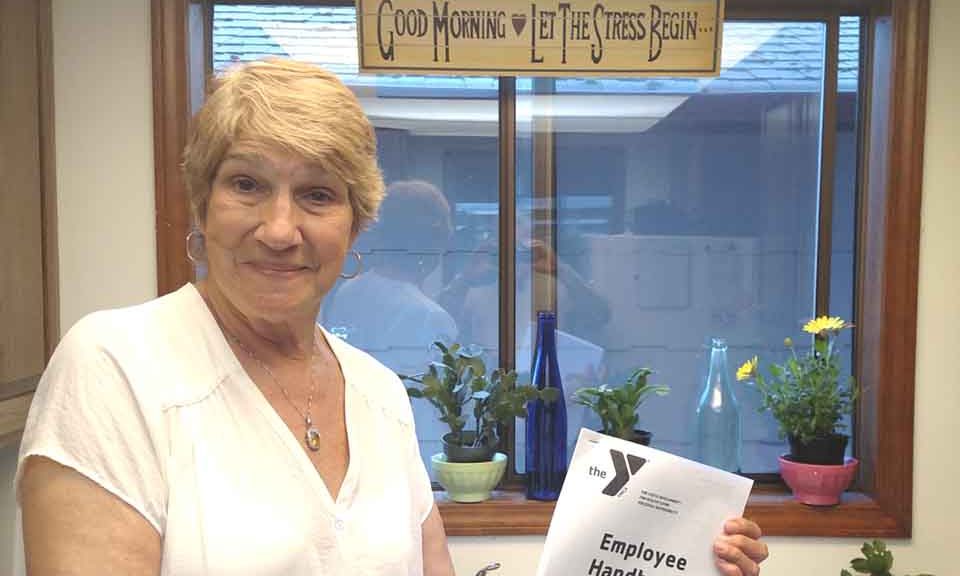
After beginning childcare duties on May 15th with the YMCA of Southwest Washington in Longview, Alice McCormick received the following email from the facility’s executive director on June 7th:
The Y’s Rainbow Corner “has some concerns about your communication skills with kids and parents [emphasis added]. Because you are still in the 90-day probationary period, she [the Rainbow Corner’s director] is letting you go because she does not feel like this is a good fit for our members.”
Alice never returned an invitation to speak further to the Y about its decision, so I pressed Alice to forward me the terse communiqué. Once she did so (after two months), I wrote directly to the Y’s executive director who in turn refused comment to me, her life partner, or to anyone other than Alice.
My wife, Alice, can hold a conversation, but lacks the verbal pathways to do so eloquently, which self-explains her recalcitrance to hold a formal conversation with Longview’s YMCA about such an important matter without my participation. Therefore, no further communication is anticipated between us and, accordingly, I spoke with Alice to relate her impressions, and here are some of them.
The Southwest Washington YMCA in Longview
Inside Longview’s Y
The childcare room in Longview’s YMCA was touted as a “Rainbow Corner,” but painted only with a stark white color. No accompanying artwork, such as that appearing in Doylestown, PA.’s YMCA (where Alice once worked), is part of the color scheme. Half of the children’s toys were, in some way, in a state of disrepair.
The Rainbow Corner’s director expected Alice to continually consort with a mentally challenged co-worker, whom the Y was proactive enough to hire. However, the assignment convinced Alice that her speech aphasia was considered by her superiors as another form of mental incompetence. Not one person volunteered to be Alice’s trainer or a confidante.
I could go on, but Alice and I have no plans to be mean-spirited. But something happened here, and we won’t be silent about it.
Alice excelled in the field of special education and served as a substitute teacher for four years in the Philadelphia School District, no mean feat. She is an elder, an experienced parent who nurtured five children and one grandchild through childhood, teenage angst and later development. These skills remain intact.
Alice’s speech suffered significantly after her stroke in March 2015, and she found out what anyone here who does not speak American English fluently innately knows: She has become a second-class citizen. As I once quoted Hungarian film star Paul Javor in my book, Gulag to Rhapsody: A Survivor’s Story, “The less English you know, the more likely it is that people will spit on you.”
Alice deserved better than what the Y’s mission here exudes. Working with infants and toddlers provided Alice an opportunity to offer attentive caring, a safe atmosphere and love. This mission doesn’t require her to speak much. When wide-eyed children look up at her (because Alice is considerably taller than her peers), they feel love.
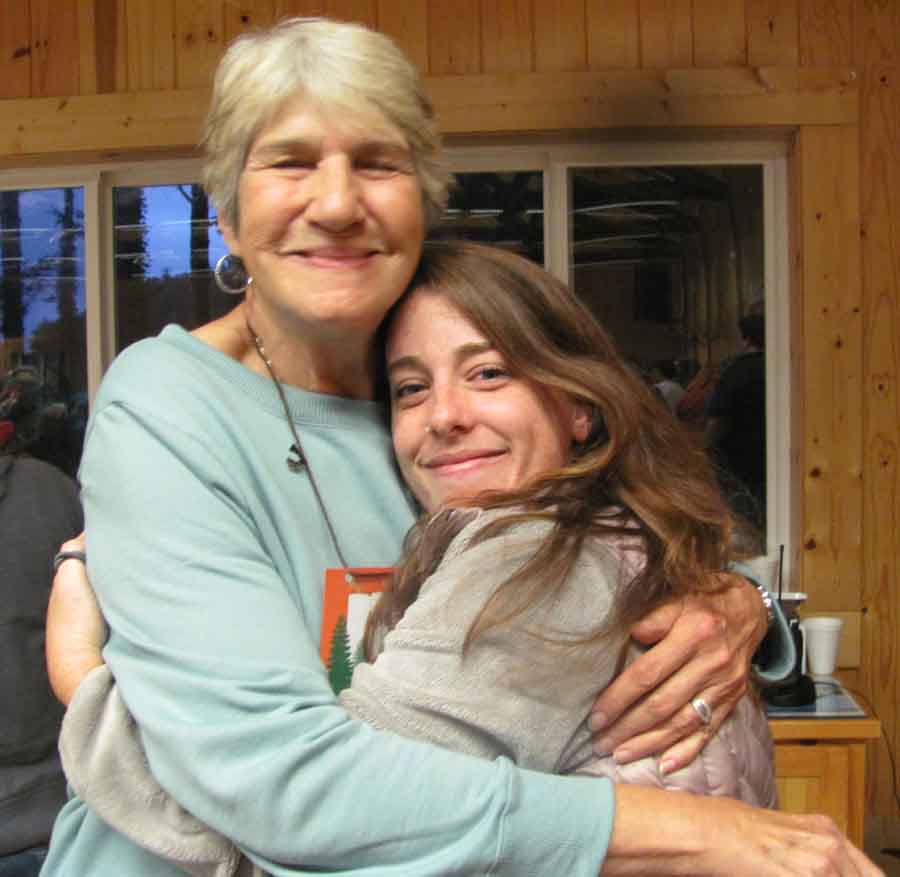
Lynn Fox, founder of the Aphasia Network, greets Alice. The woods in the background accentuate a majestic lake.
The Aphasia Network is our advocate
People with aphasia are not mentally deranged or incompetent. This is plain wrong. The pathways through her brain were interrupted by a stroke and must be rebuilt through years of therapy and practice so she can feel confident to communicate as well as the rest of us. Alice manages me, and I’m not easy.
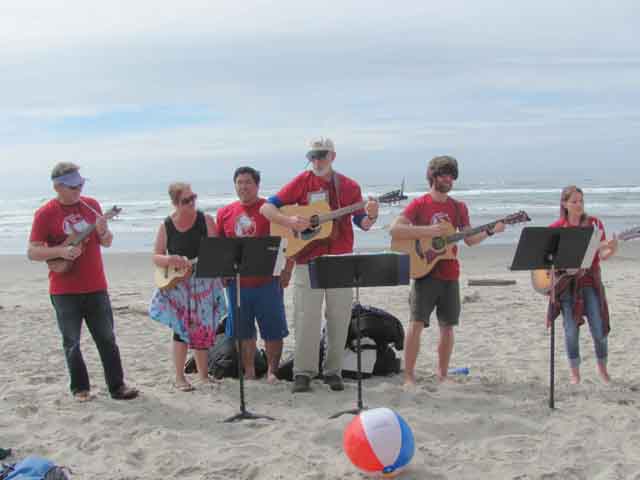
Pacific University professor John White, musician extraordinaire, leads a hootenanny on the Oregon Coast.
Two weeks ago, I broke this sad news to over 100 stroke survivors, care partners, occupational and speech therapy students and instructors at our Aphasia Adventure Weekend on the Coast. Now I share it with the readers of this blog.
Today, Alice freelances by occasionally cleaning people’s apartments. She only works for those who treat her (and me) the same way. Unfortunately, Longview’s YMCA does not meet Alice’s standards. The neighbors in our condo association do.
We remain hopeful that an aphasia awareness campaign will open new doors for people who suffer the debilitating effects of a stroke. For survivors and their care partners, more education and interaction with the outside world needs to be done.
As much as I expressed love for Alice when entering our civil ceremony seven years ago, I love her in a deeper way now. All her struggles inspire me to match her courage. Every little thing she does for me behind the scenes gives me an air of organization. Alice’s dedication to my wellbeing is akin to the Portland (Oregon)-based Aphasia Network’s ever-expanding programs.
When student therapist Megan Bravo hugs you, it’s impossible to keep your eyes open.
Yes, we are exceedingly grateful, and our gratitude is only matched by the unmitigated embrace of support offered by our delightful extended family.
Two weeks ago, Alice and I visited the Longview YMCA to tour its facilities. I have put on 20 pounds since my bladder operation, and we both could use some shaping up. Our guide turned out to be the Y’s executive director who took a keen interest in Alice’s renewed ambition to care for infants and toddlers.
The director handed Alice an application, and the two of us put together a multi-page submission, hand-delivering it on May 2. Two days later, as we prepared for a weekend with our extended family at the Aphasia Network’s Couples Retreat on the Oregon Coast, Alice received a call back from the Y.
Alice was offered a job!
We shared the good news with over 60 student counselors and staff, as well as other aphasia-recovering couples that night, and the people went wild. After three years of wondering whether she could adequately function as the professional she expects from herself (Alice’s stroke was March 12, 2015), here was the promise of a new beginning.
Back from the Coast
After our return last Sunday, Alice returned to the Y for a late-afternoon confirming interview. Two days later, Alice underwent training, and guess what?
Her first day at work is Tuesday morning.
The initial assignment calls for Alice to work one day a week. If Alice is able to progress at the Y, will I finally feel confident to take a break from driving for Uber and lately Lyft? Will I finally knuckle down and begin to write the book I’ve been bragging about?
At this point, it’s one step at a time. Four years ago, we moved to the Northwest to fulfill our manifest destiny. Now Alice is 74, I’m 75, and we’re settled in a beautiful condo apartment where we can jump-start our talents.
No one should mistake my criticism of how I lost my virginity at the American Boychoir School as a condemnation of the institution itself. A previous post on my website goes into detail here. Followup posts can be viewed here, here and here.
Its founder, Herbert Huffman, dedicated his life to growing a selected cadre of gifted musical boys into a nationally beloved choir in Columbus, Ohio. Huffman oversaw its move and transition to the academically elite community of Princeton, NJ, where boys explored a community where they learned it was acceptable to learn as much as they could – as fast as they can.
That’s quite a contrast to the peer group pressure exerted by boys in Miami’s suburbs of Hialeah and Miami Springs, where I grew up. When I returned there in the 9th grade, classmates asked me not to do so well academically, “because it makes the rest of us look badly.”
I coasted, and made straight A’s. That’s how outstanding my Princeton education was.
More than 50 years after a twisted genius by the name of Donald Bryant orchestrated a loss of institutional control, the Princeton-based Boychoir’s inmates have finally taken over. Some of what transpired was revealed in well-written investigational stories by the New York Times and New Yorker magazine. Boychoir management only sought to quash these sensational revelations, revealing a serious disdain for transparency.
After I wrote my own story here of encountering a sexual predator, I heard enough response to sense a troubling undercurrent of suspicion resided in the surrounding area of Bucks and Mercer counties from women who had married previous members of the Boychoir. The lid of damnation that caused editors to censor stories about the American Boychoir had backfired. Eventually, bankruptcy was the only course the venerable institution had left.
The people I refer to as “inmates” are its new leaders, men who have matriculated through many of life’s pitfalls. They are accomplished in their fields and recognize what the Boychoir meant to them and its potential to future generations.
According to Kris Brewer, spokesman for the resurrection committee, “It is a shared sentiment and goal to make sure that if we are successful … that acknowledgment, transparency, learning, prevention and healing are essential to the success of the Foundation and a future ABS… We are not interested in keeping silent about or hiding the past. It does no one any good now or in the future.”
Chet Douglass and Aaron Smyth are joining Brewer to step forward as a triumvirate and promulgate a concept as time-honored as Christianity itself – a resurrection.
My personal story is meant to bequeath their cause far more than the $10 gift I donated; it is meant to inspire Messrs. Brewer, Douglass and Smyth to continue and persevere.
Back in the winter of 1955, I auditioned for Herbert Huffman, founder of the Columbus Boychoir. I don’t recall much of that audition, except it took place in Coral Gables. I remember Huffman as a gentle soul, whose interest in great music was legendary.
I remember my mother spoke with Huffman privately after I sang for him. I don’t know if she told him about my father, Virgil, but he was a tormented musical genius who once played with each of the Dorsey brothers in New York City, but evolved into a frustrated musician who savagely and frequently beat me for no reason at all.
At home, I had retreated into a private world in which I pretended to be a television programmer. (The quality of my first journalism gig – a TV writer – reveals how much I used media for an escape.) I developed a good singing voice by singing in the shower, and my mother, Thelma, who played piano for the First Presbyterian Church in Hialeah, hoped to get me away from my father’s physical abuse.
I was chosen, an unlikely selection because of the pigment of my skin. During the spring, summer and falls of my life, Virgil took my family to South Beach where we played with other boys on the soft sloping sands along the Atlantic Ocean. The constant exposure of the sun on my skin darkened me considerably; however, brothers Jon and Chris turned red from the exposure and suffered with serious sunburns. I sometimes burned, but kept getting darker and darker.
At Albemarle, where I lived in a dormitory setting with the other choirboys, I never thought of myself as outside the cultural norm until one day. We previewed a never-before-seen video film taken of us while performing a sacred choral piece. Each choirboy – one by one – was paraded before a camera while singing a Christmas hymn. The film was ready and edited with sound, and we were the first to enjoy it.
Because I tried not to care, my nonchalance was rewarded. I never saw myself! But some other boys said they had, so the film was rerun for my benefit. I didn’t see anything distinctive, except for an apparent Negro boy who walked through. I recognized almost everyone else. Who was that black kid?
“That’s you!” the other boys exclaimed. “Look again.”
Once again, the film was rewound to where I walked through. After strong urging, I recognized some of my features. I was the black one!
No way, I thought. What was going on?
After all these years, I think I understand. Because of the lighting used in the newspaper and on TV channels that was specific only to me, I appeared white and Caucasian. Compared to the other boys at the school, though, the camera portrayed me as dark.
Herbert Huffman chose me despite my complexion, because he saw the potential of my musical gifts. I played piano well, and I was a decent second soprano. So Huffman rescued me from my father.
I never revealed these details before, so you, readers of this blog, know them for the first time ever.
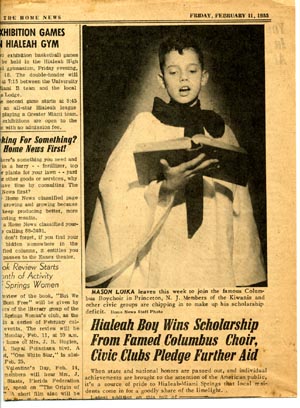
I saved and scanned the official story about me written courtesy of Jay Morton, publisher of the Hialeah Home News who on Feb. 11, 1955, announced my selection to the Columbus Boychoir.
(By the way, Jay Morton was no ordinary publisher. After studying art at the Pratt Institute in New York, receiving a master’s degree in Paris, he had moved to Miami to write and draw the animated cartoon, “Superman,” for Fleischer Studios. He was responsible for describing Superman as “faster than a speeding bullet, more powerful than a locomotive, able to leap tall buildings in a single bound.” He also drew Felix the Cat, Betty Boop and Popeye.)
As publisher of the Hialeah Home News, in the 1940s and ’50s, he ran a one-man crusade to drive the Ku Klux Klan out of Hialeah. He passed away on Sept. 6, 2003, the same day as my late brother Jon’s birthday. I am proud to share the text of his article verbatim, especially because it contains no typos, as follows:
Hialeah Home News runs story about Mason Loika, Choirboy, on Feb. 11, 1955.
When state and national honors are passed out, and individual achievements are brought to the attention of the American public, it’s a source of pride to Hialeah-Miami Springs that local residents come in for a goodly share of the limelight.
Latest addition of this roll of honor is little Mason Loika, son of Mr. and Mrs. Virgil Loika, 810 N.E. Third pl., Hialeah. Mason left this week for Princeton, N.J. where he won a scholarship at the nationally famous Columbus Boychoir School.
Mason looks like any other boy who is almost 12. His brown locks have a tendency to be unruly with a cowlick indicating, as the saying goes, bedevilment. But just let Mason don his choir-robe – a long, black, monk-like skirt, a white, wide-sleeved tunic, and a big, black bow under his chin …
Then he’s transformed into an angel, and surely sings like one.
That’s what Herbert Huffman, director of the Boychoir, thought when he auditioned Mason at the University of Miami two weeks ago. Huffman and his boys’ ensemble were here for a concert, and the Loikas felt fortunate when he consented to hear Mason’s voice.
Their joy was irrepressible when Huffman offered the boy an $800 scholarship at the non-sectarian school. But finance reared its ugly head. A year’s tuition, room and board, costs $1,600. The Loikas could raise $400 on their own, but where was the other $400 coming from?
That’s when Mrs. Loika came to the Home News (he is a Home News carrier) to pick up Mason’s papers. The story came out, and Publisher Jay Morton resolved that, if he could be of help, this opportunity and honor would not be bypassed.
Morton has been on the phone soliciting support from the city’s civic organizations and this week when Mason departed it looked as though his dream would come true. The pledges aren’t all in yet, but the Loikas are proceeding on faith.
Mason’s father is now employed at Pan-American, but he has 25 years as a professional musician behind him. He gave his son all the training he could. Mason’s mother, a music-teacher and music instructor for kindergarten, has been giving him piano lessons.
At Princeton, Mason will have a regular curriculum which will cover at least what he’s learning now in the seventh grade at Hialeah High. He’ll also have choir practice twice a day, plus individual voice training.
The Columbus Boychoir is renowned throughout the country. Besides appearing at festivals and secular gatherings, the boy choristers have been heard on national hook-ups of radio and television, and in recordings. They were on Ed Sullivan’s “Toast of the Town” at Christmas. They always “bring the house down” at every concert they appear in.
Just as Mason won applause at the Kiwanis club luncheon on Tuesday. While his mother accompanied him, his childish treble rose in melody and he won the hearts of the Kiwanians.
You know that feeling that overcomes you when functioning blind? Not literally, but the sensation realized outside one’s comfort zone. Visually, you can approximate the feeling by driving in foggy conditions, where you literally can’t see eight feet in front of you.
Never suffered any mishaps with this fine-looking limo. Photo taken on the grounds of Solebury School, New Hope, PA.
In Pennsylvania, I experienced that dysfunctional feeling several times while driving a six-passenger stretch limo, especially on icy roads, climbing the top of a snow-covered hilltop manor’s long driveway, or the disgustingly narrow Washington Crossing bridge during an ice storm, and especially downtown Philly’s jammed South Street during New Year’s Eve. My first trip to the Dakota in Manhattan, where the late John Lennon lived, produced a similar tingling the first time I pulled inside the covered driveway of the famous 72nd Street building.
Anyway, I digressed, as I am wont to do. Alice and I recently moved to Longview, Washington, escaping from Portland, Oregon’s growing pains and rent crisis, accompanied by a reprise of asking what happened to our stuff.
To recap, Alice and I managed some serious downsizing before moving West, so that all our possessions at our two-year Portland location were contained within a 900-square-foot apartment, plus 30 boxes of assorted stuff laid about a dusty, dingy garage.
We already had some heart-stopping moments moving out West and you can read about those here. (Follow succeeding posts in the archive to learn the resolution.)
Preparing for our second move in three years
In looking around the Internet, which is how almost everyone functions in Portland, I came upon a moving company based in Vancouver, Washington, that specified its territory includes Longview and Portland, with nothing else beyond. I put down a $100 deposit, and arranged a moving day for September 27th.
As typical, a plethora of tasks were left to the last minute, so we awoke before the sun did. As the 8 o-clock AM hour began to wane, my phone rang, and the young driver managing our move explained he and his crew would arrive around 9:30. I gave him instructions how to find our apartment, and like clockwork, three strapping young men showed up on time in a 17-foot-long box truck.
The rented garage across the parking lot was summarily emptied. While we carefully moved our respective desktop hard drives and monitors into the Ford Escape (“Betsy”), the crew set upon the entire apartment beginning with the upstairs bedrooms. The queen-sized bed was disassembled, and everything appeared well organized. My fragile, well-used computer hutch was deftly moved outside.
Two flat-screen televisions were wrapped carefully. Our newly purchased extra-long sofa was carried outside by two of the guys with nary a complaint or mishap. As the truck’s contents rose to its top, new rows of stuff utilized its full width. Alice and I were amazed how the guys managed to fit EVERYTHING into a small, contained space.
Nothing more could fit inside the moving truck. While the movers were doing their thing, we toted the computer peripherals into the SUV with the rest of our PCs, nonetheless saving a prime space for Millie inside her cat carrier. Alice packed some odds and ends from the fridge, enabling us to munch upon sustenance during the upcoming 50-mile drive. Amazingly, everything was packed inside our respective vehicles by 12 noon.
Before setting off to our new Longview address, I asked the driver/supervisor of the crew if he was going to drive to Longview using US-30 (St. Helens Road) paralleling the Columbia River, which involves a nearly 1,500-foot ascent and descent over Cornelius Pass, the route we planned to take. He declined, saying the crew requires a lunch break in the Vancouver, Wash. vicinity and that they “probably” would take the I-5 route to Longview.
We said goodbye to the truck, professional crew and 99% of our stuff, as we set out to Longview. I called the carpeting/flooring installer to alert them of our arrival, checking to see if everything was copacetic, only to discover that a problem area in the upstairs bathroom required the crew to work until the midnight hour the previous night.
Arriving in Longview
The carpeting and flooring were in place though, the salesperson assured us, and all was ready for our arrival. However, when we drove up to our newly acquired garage to unload Betsy’s booty, the carpet people were still working.
“Oh crap!” I thought, although a full crew was hastily vacuuming our newly installed carpet, promising apologetically they would finish in half an hour. In anticipation of that deadline met, we unloaded the computers and emptied the car, nervously checking our watches, hoping the movers’ arrival would not be imminent.
“Ask, and ye shall receive.”
While waiting for the movers, Alice made sure the front door was clean and spiffy.
A half hour went by. Then an hour had passed. I checked the elapsed time again: an hour and a half!
“Where’s our stuff?” I worried.
Finally, I received a text from the driver: “Got stopped at weight station. Getting inspection done. This time will not count toward your bill.”
“Ah, finally,” I thought, wondering about the station’s location, but relieved to know there was only a slight delay. An hour passed without further word, so I texted the supervisor again, “What is your status now?”
Within a minute, I received a reply. “We are stuck at weight station. There is a problem with our insurance. We are getting it figured out. I will let you know as soon as I know more.”
My heart sank. “What in God’s name?” I mumbled. I wrote back, “Is your truck being impounded?”
“No,” came the reply. “Just can’t leave until the system is updated.”
By this time, several of our new neighbors had gathered around, volunteering to help as much as they could. I looked around and texted, “All our neighbors are hanging about to help us with the move.” I asked for directions to the weigh station, hoping my appearance could smooth a quicker arrival for the truck.
“I intend to drive there and see what I can do,” I wrote.
“One second,” was the answer. “There isn’t much you can do. It’s an issue with our insurance. They messed up somehow and are working to fix the issue.”
Five minutes later came a phone call from the moving company’s female representative, whom I surmised was the moving company’s part-owner, and she revealed the awful truth. Our moving company did not have the proper INTERSTATE insurance paperwork that permitted it to operate a commercial moving business from the State of Oregon to Washington.
The Washington State Police had impounded the truck, refusing further movement into Washington, although its contents belonged to Alice and me. The only way this stalemate could be solved legally, the woman said, was for me to pick up a rental truck, pick up all our cargo, and drive it back personally to our Longview address.
WTF! The owner was asking the impossible. He wanted me, an Uber/Lyft driver at the ripe age of 74, to pick up a U-Haul rental truck large enough to hold our possessions – 20 feet long, but lower in height.
Heading south on Interstate-5
The clock read 4:30 pm as I proceeded to correct this move-it-or-lose-it situation. After one wrong inquiry at a location where I received blank stares, I arrived at the correct rental spot, whereupon I learned that credit card info given to U-Haul turned out to be “not authorized.” I waited around, twiddling my thumbs, until the owner of the moving company, who shall remain nameless, volunteered a different, acceptable credit card that absorbed the $204.29 charge.
Remember what I wrote about the feeling of operating blind as I began this website post? Sure, I had experience with limousines, Lincoln Towncars and driving for Uber and Lyft, but steering a 20-foot-long truck in a manner compatible with other commercial drivers along Interstate 5? Before I was able to realize the full extent of my dread, another “sizable” problem:
“I am stuck in Longview rush hour traffic adding another 10 minutes to my trip,” I texted the moving truck supervisor. “There is a narrow lane that I am coming to, which is only 10 feet wide. Do you think I will have a problem clearing that part of the road?”
No response. The silence was deafening.
I gripped the steering wheel tightly in true white-knuckle fashion, barely clearing the dreaded, offending section to emerge onto the busy interstate highway and drove like I belonged there. Nevertheless, I proceeded watchfully, looking for the weigh station 20 miles southward.
The weigh station was mostly empty, a fitting scene for the empty feeling in my stomach.
Once I recognized the station on the northbound side south of Exit 16, I turned around at the next exit. I pulled into the offending area where I was met by the same Washington State patrolman who was the bane of our movers’ existence. I identified myself by displaying my Oregon driver’s license.
“Okay, you can drive the truck back after it is loaded,” he ordered, “but only YOU can drive.” He then had me claim our possessions.
Was this a official order by the State of Washington or an invitation to a mishap?
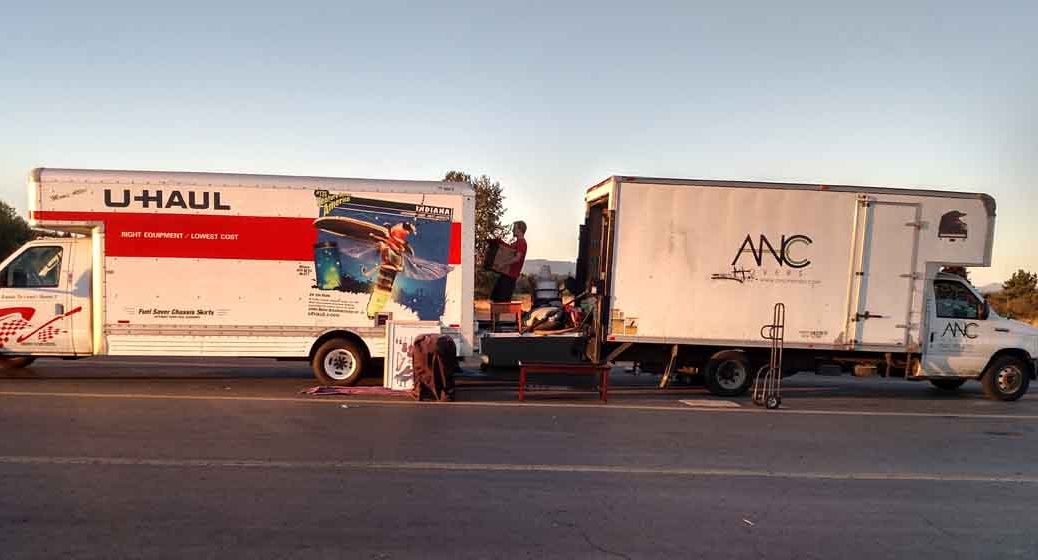
My watch read 6:30 pm, Mount St. Helens was visible in the distance and the Washington State trooper allowed the transfer to commence with one more notable proviso: The contents of the moving truck were not allowed to be unloaded onto the tarmac until reaching the back door of the U-Haul. Everything inside the movers’ truck had to be rearranged, due to the major difference in dimensions of the two trucks. Nevertheless, the moving crew’s supervisor managed to direct the whole shebang in 90 minutes. None of our possessions were left behind, damaged or even dented during the entire ordeal.
The logistics in motion appear as the cover photograph of this post.
The first crew did their part, now it’s my turn
Then came the fun part. I drove a fully loaded 20-foot rental truck – filled with all our possessions from our seasoned lives — onto a frenetically busy interstate highway in the dark of night for a full 45 minutes – past mountainsides and over Washington’s military-green bridges.
As tightly as I gripped the truck before it was loaded, I believe the veins on my wrists were on full display as I steered the truck – which seemed to have L-O-O-S-E steering. I slowed the truck to ridiculous speed at every turn I encountered, until I pulled into the condominium’s driveway in front of our new residence. A new moving crew had been dispatched to greet me, and I noted the time: 8:45 pm.
“Would you mind backing the truck toward your garage door?” the new supervisor asked. I pulled forward about 10 feet, put the truck in reverse and proceeded warily until my new “friend” yelled out, “That’s okay. I’ll take it from here.”
I hit the brake, put the gear shift into PARK, and when I stepped down from the truck’s running board, I saw why he relieved me. I backed up the truck within a foot of the garage door. I could have hit the damned thing!
Whew! I was nearly done. The crew stayed with us, asking where we wanted every item of furniture or box to be placed inside our newly carpeted, sumptuous apartment. The moving crew worked tirelessly and when they were finished – at 11:30 pm – they said goodnight.
No one presented us with a final bill, and nothing more was communicated to us ever again. After 2½ months of silence, it’s safe to assume the final bill was the $100 deposit for the initial contract. After all, in return for my participation, the owner’s wife promised a “substantial” discount for getting the moving truck and crew released from their Washington Weigh-Station impoundment.
My furnished office is an occasional haven for Millie. She was very content to sleep in the author’s chair the night we moved.
I don’t remember how we ate that day. I know I slept like a rock after going to bed at 2 am. Nevertheless, we’re happy in our new condominium, and Alice believes we will never have to move again.
That’s terrific news, because I never, ever want to ask myself, “Where’s our stuff?” again. That shit gets old – fast.
Thanksgiving is a time when one is supposed to feel grateful. This year, though, I believe my gratitude is far more abundant than at any other time in my life.
One particular cause of such supreme gratitude is our condominium unit and the community we now live in. Alice and I thank my cousins, Margaret Johnston and Carolyn & Jeff Levin, for investing in our vision, transforming us into stewards of a beautiful property overlooking the mountains of Washington. If it were not for them, our place would not be as spectacular as the view.
24-unit condo community with a view
The hills of Washington underneath a sullen sky.
Take a peek outside my second-floor writer’s office window. That’s one of several mountain ridges in the distance where a few developments punctuate the landscape. Frequent rain events during the fall/winter obscure their top-of-the-mountain view more than ours, which encourages a certain personal, snobbish feeling of superiority. And during an occasional burst of heat during the summer, a smaller ridge to the southwest shades our valley community an hour before dusk.
Inside the Loika/McCormick home
After DishTV installed our TV on a wall mount, the workmen insisted their sound system is better than Bose. I turned them down, and I’m glad I did. Check out the stonework for the fireplace.
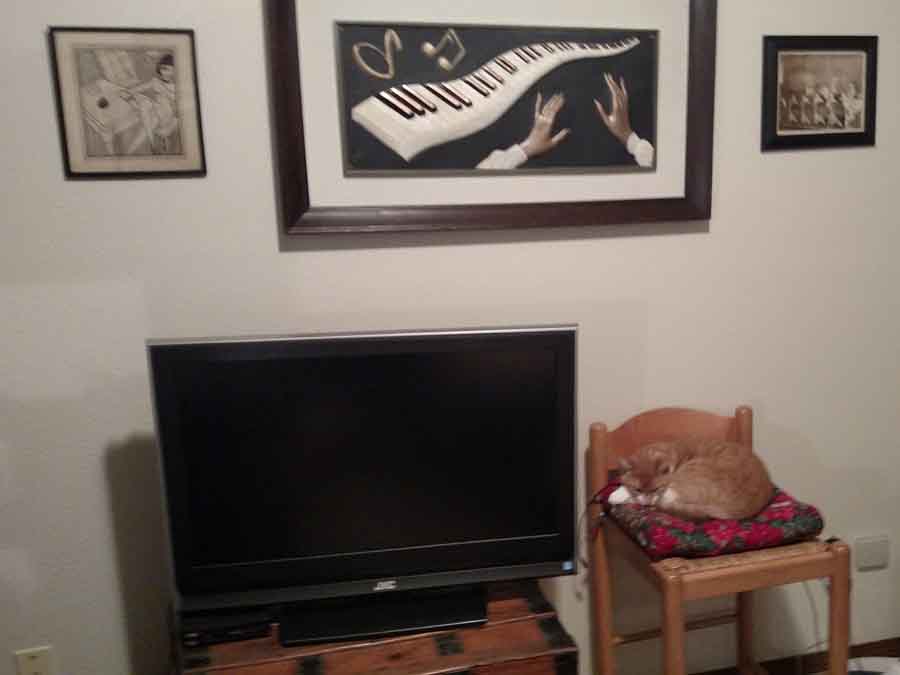
Our living room has become an audiophile’s wet dream. The television is mounted on the wall and the audio connected to my Bose surround-sound system. Before we moved in, Reid Rasmusson, a local Longview painter and stalwart resident who has knowledge of our building’s architectural history, applied several coats of paint to the entire apartment. What stands out is how Alice directed Reid to reinvent a cranberry-red wall into a more-aesthetically pleasing olive-brown accentuation to an artistically constructed fireplace. An added attraction, thanks to Bose: the acoustics are outstanding.
Instead of watching MSNBC, Alice now loves quiet time early in the morning before I awaken.
Therefore, one wouldn’t blame Alice for reclining on our six-month-old sofa toward the entertainment center. But that’s not her usual position. Alice lies in the opposite direction, sharing my outside view, but the downstairs window position aligns her 6-foot frame next to a riot of greenery. Already, Alice is adding her creative touch to the outside backyard.
(Our cat, Millie, complains loudly every day of wanting to go outside and explore. But we hear that bobcats, cougars and coyotes prowl about, so we admonish Millie for expressing reckless desires and keep her inside.)
After Reid finished painting, the carpet people showed up to execute our carpet and flooring plan. Every old piece of carpet was discarded in favor of a tan-colored replacement, with a luxurious feel and look we enjoy today. The carpet installers were finishing up barely moments before our movers were scheduled to arrive. The movers? That’s a different story, and a future post will detail the story of that near-disaster.
Never before saw a light shaft like this.
One particular view of the upstairs railing reveals light shining through the upstairs bathroom. (We have 1½ bathrooms, by the way.) That’s sunglare coming through the bathroom skylight. That’s cool, isn’t it? A skylight for the bathroom? Oh yeah, try to get that in a condo in Portland!
A feeling of community
If you get accosted in a Mexican restaurant, can ICE deport you?
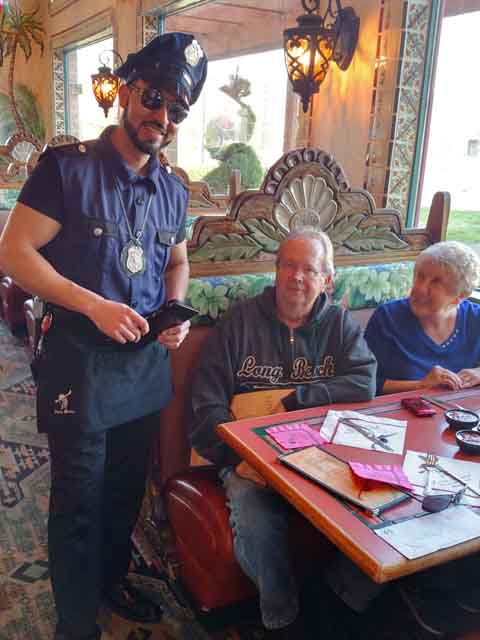
Our digs are so splendoriferous that I hesitate to include the generosity of spirit from our neighbors. Nevertheless, I’m dutybound to report our next-door neighbors meet two criteria: quality and congeniality. Terry and Carole Sumrall introduced us to a restaurant they favor: Fiesta Bonita Mexican Grill and Cantina. Of course, our journey turned out to be a late afternoon on Halloween, so the tradition in town conjured up a wannabe for the Village People instead of a waitperson.
Other neighbors are equally generous with their time and talents. Already, Longview is full of revelations, and the history of this town is worthy of more national attention than it gets. This is a true community, and my future writing here may reveal what I call “living in a Gentile kibbutz.” I only wish I didn’t have to drive to Portland to buy whitefish salad, a proper bagel and latkes. Or cheese blintzes! A full story about Longview, Washington will appear in a future post, or perhaps be contained in the book I committed to when moving West.
The photo at the top of this post was taken by one of the employees at Teri’s Restaurant in our newly adopted hometown. Besides a continuous dedication to provide restaurant fare a cut above the standard, Teri’s is a hubbub for local musicians and their groupies. (No age requirement to become a groupie.) We met a dean from Lower Columbia College (in Longview, naturally) who got on one knee in front of us to encourage Alice to return to work for child care. How is that for a welcome?
A quick apology
Please excuse the delay in getting this post written. There were plenty of chores for me to take care of, not to mention the time I wasted while being hooked on DishTV during this college football season. Yes, I am still functioning, sometimes badly, on the aftermath and life after a bladder removal surgery.
But I am far more than just alive, and I’m married to an Amazon woman who sets a pretty high standard for how she looks after me. That’s why every time she allows herself a genuine smile, my heart continues to go pitter-patter.
Dr. Seuss said, “You know you’re in love when you can’t fall asleep, because reality is finally better than your dreams.”
On her birthday in March of this year, Alice told me, “This year, don’t buy me anything. Instead, please, please get me a house.”
Alice realized the bloom had fallen off the Portland Rose City. We started looking around and found a two-story townhouse for sale in Longview, Washington, next to a public golf course. The photo above shows the crown jewel of Longview: Lake Sacajawea, a former channel of the Cowlitz River turned into a picturesque manmade lake, surrounded by 67 manicured parkland acres. Live music fills the air on six consecutive Thursday night concerts.
Alice and I were in a difficult spot, because we didn’t have money for a down payment. We were caught up in Portland’s rent crisis, and each year an increasing amount of money was being squeezed from us to rent a tiny 900-square-foot apartment next to a major freeway.
Eddie McCormick was recently honored as a Navy Seal.
Mason Was a Navy Reservist
Thinking about my Uncle Eddie McCormick, though, led to an overdue realization. During the early 1960s, Eddie convinced me into joining the Naval Air Reserve. As far as the Armed Services were concerned, I was not a “man’s man.” This was especially true after I took the Navy’s aptitude test and set a new record for LOWEST score in mechanical ability. Eddie suggested I join the Naval Air Reserve’s six-month active duty group known as “Weekend Warriors.”
During that era, I was subject to the draft. So I enlisted as a preventive move and served six months of active duty – from October 6, 1960 until April 5, 1961, followed by 5½ years of active reserve duty spending one weekend a month at Jacksonville (Fla.) Naval Air Station and serving two weeks active duty during the summer. Most of those two-week tours took me to Guantanamo Bay, but my experience did not include combat, thank God.
After my discharge, I discovered legislation that disqualified 1960s reservists who served 180 or fewer days active duty from receiving VA benefits. This was a strike against six-month reservists, and I harbored resentment about the limitation of opportunity and expressed it to Uncle Eddie a few times.
Embracing a Revelation
Eventually, I found my niche as a broadcaster turned journalist, and regarded my military service as irrelevant history. My military history soon became relevant as I wracked my brain figuring out how to finance a condo purchase. I don’t remember how a flash of brilliance overcame me, but somehow I started counting my days of active duty from October 6 through April 5. That added up to more than 180 days, it was 182.
Oh my God, the commander at Jacksonville Naval Air Station must have mustered me out two days late. I was qualified!
Alice is greeted by the condo association president. We would share this backyard common area with one other resident.
Realtor Tami Cheatley was super-skeptical about VA financing, though, shunning it with a passion, but the Veterans Administration proved it was there for us. It recognized Alice and me as a married couple, and acknowledged my service. Oh yes, the VA did exact their pound of flesh, requiring me to document numerous explanations of every black mark our credit suffered over the last seven years.
We needed to get files from years past, copies of court judgments, visit the IRS, give every possible explanation for any bump in the road we experienced in life. But we did it, and today, on Eclipse Monday, we closed on the sale.
Mason and Alice celebrate with a cold bottle of sparkling wine, just itching to have its cork popped..
As we celebrate our hard-won victory today, I acknowledge what Uncle Eddie did for by getting me into the Naval Air Reserve. And I dote on his memory. So congratulate us, for today Alice and I became homeowners in a quiet, desirable neighborhood.
I participated in the American Boychoir School’s 75th anniversary concert at Saint Joseph’s Seminary in 2013.
In a July 2016 post, I wrote about my unwanted encounter with a pedophile in this heart of cultural civility, Princeton, New Jersey, in the mid-1950s. Anyone who wishes to read that post can find it here: sexual-predators.
The American Boychoir School never offered an open, frank discussion about rumors about its past. People whispered and wondered what had gone on, and the School continued to stick its head in the sand. I was there when a children’s show on Public Radio called “From the Top,” a showcase for young classical musicians, used the school as a setting for one of its young artists’ shows.
In 2014, Dustin Hoffman starred with Debra Winger in a movie called “Boychoir” that used the American Boychoir School as a backdrop; however, it only received limited release to tepid reviews. Hallmark Cards bought the movie, retitled it “Hear My Song” for national exposure on CBS-TV until the company learned of the New York Times archived exposé of the school’s sordid history, and the showing was quietly shelved. TV Week revealed the reasons Hallmark backed away in an article available online.
Here’s an update. The school is coming to an ignoble end. The American Boychoir School is abandoning its efforts to emerge from Chapter XI bankruptcy. It will close down. You can read about it here: boychoir school to close.
There is no joy in seeing the American Boychoir School go bust. But there is a high degree of poetic justice. This chapter of my childhood has reached its ultimate end.
Since Alice and I arrived as mid-Atlantic transplants to the Left Coast almost three years ago, driving around, through and beyond Portland has revealed a downside of the Rose City. Over 600,000 of the city’s residents – over 2.3 million are cramped inside a flexible, but meticulously zoned, metro area – populate this formerly pristine forested area. Many locals reveal a thoughtlessness attendant to litterbugs who discard fast-food trash and cigarette butts carelessly. Franchised McDonald’s and Burger Kings are high-stakes fixtures to some of the worst body shapes we’ve seen in America.
Our patio reflects Alice’s care and love of gardening. But what’s next door?
Next door, garbage is piled outside, attracting vermin and flies, and dog waste accumulates in the backyard. The apartment’s residents use the patio as a smoking area — yech! And complaints go unheeded.
“Portland is the fastest growing metropolitan area in the country,” say a myriad of surveys comparing growth here with the rest of the country. City administrators wring their hands about a town that grew into a city and now create “zero-death” goals, because driver impatience or carelessness no longer resolutely yields to pedestrians and bicyclists. Freeways have become obsolete, because of bumper-to-bumper traffic on all roads leading into and out of downtown. City fathers and mothers speak openly about charging everyone a mileage toll for driving on city streets, enforced by mandatory GPS counters.
Homeless beggars jockey for freeway exits to display their homemade signs pleading for money. Buildings sprout upward at an astonishing rate, with new construction closing lanes around almost every block. Artists and people on fixed income complain about being priced out by the workers from high-tech industries, the two largest being Intel Corp. and Nike.
Most bridges across the Willamette River that bind the East and West sides together are always under construction in one form or another, as a nonstop crush of trucks, cars and buses steadily pound the newly added improvements into submission. Portland’s traffic ranking is worse than Philadelphia.
Driveways inside apartment complexes as well as residential streets are pocked with speed bumps, serving as automated enforcement of sensible speed limits. Portland police do not have the manpower to enforce restricted lane-changing. The turn lanes of downtown roads onto stop-and-go freeways outgrew their capacity years ago, and there is no room to add new infrastructure to accommodate exasperated recent arrivals.
The TV series “Portlandia” reflects the Chamber of Commerce image of the area; it serves as “Fake News.”
I have seen the urban side of the Great Northwest here, and the future doesn’t portend well. As an Uber driver over two years, I shared Betsy, our 2010 Ford Escape, with almost 3,000 riders and now realize this West Coast enclave has capitulated to the millennial nerd rush from Silicon Valley, California. With matching prices to boot, greed rules the mindset of today’s landlords and homeowners in the Rose City area. Alice and I are struggling to keep up with rising rents in our complex adjacent to a busy freeway. And visitors from Seattle, Los Angeles and San Francisco say it’s even worse there.
Here’s the good news: We found a place that would accommodate us nicely and not flaunt our presence. Two weeks ago, we made an offer to buy a two-story townhouse (listed as a condominium) in a quiet neighborhood 40 miles from Portland, where the unfettered sound of freeway traffic, police and ambulance sirens will become an unpleasant memory. I will not elaborate more yet, because we await word from the Veterans Administration to see if we qualify for a mortgage with no money down.
We do not wish to jinx our prospects, because the universe is working on our behalf.
Now it’s time to savor our reclining years. It’s also time to get off my duff and write a book in earnest about my life. Because Betsy’s air conditioning system is scheduled for repair on July 17, I will have time, albeit involuntary, to reinvigorate my creative juices. Alice will also feel more independent with the car at her disposal.
The last offspring of Mason Johnston and Grace Brantley passed away peacefully on Thursday, Jan. 5, in Chesapeake, Virginia.
Grace Wiley Johnston McCormick reached the age of 90, and in doing so, she embodied the name “Grace.” My grandmother must be clapping her hands excitedly, exclaiming “My-oh,” anticipating her final daughter’s entry into that other existence to which we are headed. There is no doubt that the two Graces are being reunited.
Husband Eddie McCormick took pride in this artist’s rendering of Cypress Point.
Grace Wiley was married for 65 years to Eddie McCormick, a Navy seal whose valiant service in World War II speaks of a dark world he once inhabited. Grace bore up to Eddie’s demons, keeping them invisible to the outside world with nary a complaint, reflecting what it means to live up to the name “Grace.”
Grace Wiley and Eddie gave birth to two wonderful children: Barbara and Michael. I became friends with them both, and I bless the day we became related. Each of them manages his or her respective worlds under tenuous circumstances, and their daily sacrifices reflect on the quality of Grace’s motherly essence.
Barbara’s pride and joy offspring is named Dylan, who was conceived with her late husband David. Michael, who regularly sends up dog apples to his dearest companions, enjoys a continuously bountiful marriage with wife Kim, which produced Cameron, Corey, Kyle and Kara.
Cypress Point was a stark picturesque viewpoint in Surrey, Virginia, across the James River from Jamestown.
Here’s what Barbara and Michael wrote about their mother: “She loved everyone and never said anything bad about anyone. The word ‘hate’ was not in her vocabulary,” and they go on to relate how Grace was not shy about remonstrating her children if anything resembling “defugalties” fell from their mouths.
Barbara and Michael recall how Grace helped others any way she could, especially migrant workers. “She was a very tough individual and never complained about pain or circumstances. I think a lot of that came from growing up on the farm picking cotton and eating collard-green sandwiches.”
I, Mason Loika, am honored to have matriculated on my mother’s side through such fine family stock, and whenever I should feel frightened or alone, I have the advantage of recalling vivid memories of fine personages who set a high standard. Grace Wiley McCormick was one of those amazing good hearts, and I am glad to hear that she passed peacefully while in God’s waiting room.
Grace Wiley’s memorial service takes place tomorrow morning at Cradock Presbyterian Church, where her family worships on a regular basis. They ask nothing for themselves; rather, that all contributions go to the church.
Alongside her mother, Grace Wiley now joins her other siblings: Richard, Gladys, my mother Thelma and Bill. In doing so, I become established as a next-generation elder to humbly salute the Johnston quintet along with their respective offspring.
On the 10th day of January, 2017, the Johnston family stands tall and proud amidst a glorious treasure chest of memories as we pause at 11 am Eastern Time to salute one more family hero who has passed over: Grace Wiley McCormick.